
In today’s fast-moving digital world, creating content is not enough. I’ve learned that optimizing content is what truly makes the difference between a blog that gets ignored and one that actually ranks, engages, and converts. This is where AI tools for content optimization come into play.
We no longer have to rely only on guesswork or manual efforts. With the help of AI, you and I can now create content that is smarter, more relevant, and perfectly aligned with what users and search engines are looking for.
Let’s understand how AI tools are transforming content optimization and how you can use them effectively.
What Are AI Tools for Content Optimization?
AI tools for content optimization use artificial intelligence, machine learning, and data analysis to improve the quality, structure, readability, and SEO performance of content. These tools help us understand what works, what doesn’t, and what needs improvement.
Instead of spending hours on keyword research, grammar checks, and SEO audits, AI tools help us do all this faster and more accurately. They guide us on keyword placement, search intent, tone, readability, and even content gaps.
Simply put, AI helps us write content that both people and search engines love.
Why AI Tools for Content Optimization Matter Today
I’ve noticed that search engines are becoming smarter every day. They no longer rank content just because it has keywords. They rank content that is useful, relevant, and well-optimized.
Here’s why we should care about AI tools for content optimization:
- They save time and effort
- They improve content quality and consistency
- They help us target the right keywords naturally
- They align content with user intent
- They increase chances of higher rankings and engagement
When we use AI correctly, it doesn’t replace us—it supports and enhances our creativity.
How AI Tools Help Us Optimize Content
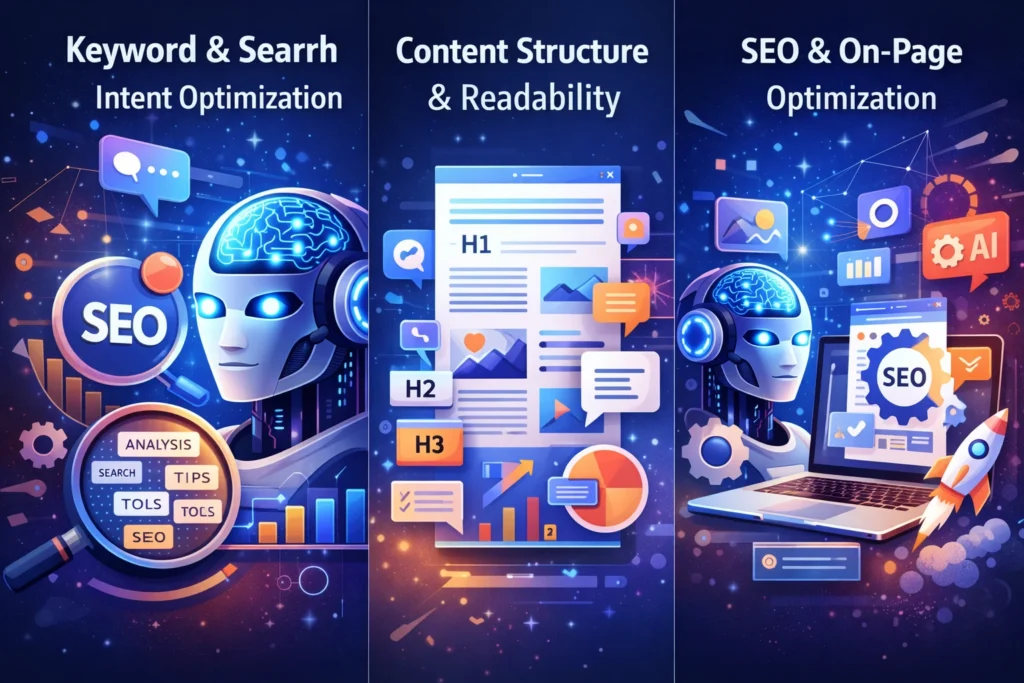
1. Keyword & Search Intent Optimization
AI tools analyze search trends and help us understand what users are actually searching for. Instead of stuffing keywords, we can place them naturally and maintain healthy keyword density.
2. Content Structure & Readability
These tools suggest better headings, shorter paragraphs, and clear sentence structures. This makes content easier for you to read and for Google to understand.
3. SEO & On-Page Optimization
AI tools guide us on:
- Meta titles and descriptions
- Internal linking opportunities
- Proper use of headings (H1, H2, H3)
- Content length and keyword placement
4. Grammar, Tone & Clarity
We all want content that sounds human, not robotic. AI tools help refine tone, remove errors, and keep content conversational—just like how we talk.
5. Performance Analysis & Improvement
Many AI tools analyze existing content and tell us:
- What to improve
- What to update
- What keywords to add or remove
This helps us continuously optimize and stay ahead.
Popular AI Tools for Content Optimization
Here are some commonly used AI tools that many of us rely on:
- Surfer SEO – For SEO-driven content optimization
- Clearscope – For keyword relevance and topic coverage
- Frase – For search intent and content briefs
- ChatGPT – For content ideas, drafts, and optimization support
- Grammarly – For clarity, tone, and readability
- Rank Math / Yoast SEO – For WordPress content optimization
Each tool has its own strengths, and together they help us create well-rounded, optimized content.
Best Practices for Using AI Tools (Without Losing the Human Touch)
I always believe that AI should assist us, not replace us. Here’s how you can balance both:
- Use AI suggestions, but write in your own voice
- Focus on helping users, not just rankings
- Avoid keyword stuffing
- Add personal insights, examples, and experiences
- Always review and refine AI-generated content
When we combine human creativity with AI intelligence, the results are powerful.
The Future of Content Optimization with AI
AI tools for content optimization are only going to get smarter. In the future, we’ll see:
- Better personalization
- Voice and visual search optimization
- Predictive content strategies
- Deeper audience behavior analysis
For us as content creators and marketers, adapting early gives us a huge advantage.
Conclusion
AI tools for content optimization have completely changed how we create and improve content. They help us write smarter, optimize faster, and connect better with our audience. When you and I use AI thoughtfully, we don’t just create content—we create value-driven digital experiences.
If you want to grow online, now is the time to embrace AI-powered content optimization.
FAQs: AI Tools for Content Optimization
1. What are AI tools for content optimization?
AI tools for content optimization use artificial intelligence to improve content quality, SEO, readability, and relevance for better search rankings and user engagement.
2. Can AI tools replace human content writers?
No. AI tools support us by improving efficiency and accuracy, but human creativity, emotions, and experience are still essential.
3. Are AI tools good for SEO?
Yes, AI tools help with keyword research, on-page SEO, search intent optimization, and content structure, which improves SEO performance.
4. Is AI-optimized content safe for Google rankings?
Yes, as long as the content is helpful, original, and user-focused. Google values quality, not whether AI was used.
5. Which is the best AI tool for content optimization?
There is no single “best” tool. Tools like Surfer SEO, Frase, Clearscope, and ChatGPT work best when used together.